Guess who’s back? Back again. Shady’s back! Tell a friend.
There’s something here.
I’m hungry.
“Write hungry,” the Spirit said to the Omer.
The Spirit moves where He wants, when He wants, how He wants.
You can’t manufacture Him, you can’t channel Him, you can’t contain Him.
No such thing as turn off or turn on.
He’s always on. You just roll with Him.
I met with a pastor who recognized my name, knew it was Old Testament, knew it was deep in the recesses somewhere, but couldn’t quite place it.
It’s a measurement.
It’s a day’s worth.
It’s “your daily bread.”
“The Daily Omer.”
Our Daily Bread has been running for decades. My grandma used to read it, my mom used to read it, and I even tried a couple. That daily devotional has been published for thousands upon thousands of issues.
But The Daily Omer is a new move, a new wave, a new beginning.
Daily is a lot. Yeast starts small. But it grows gradually.
Not writing, not sharing, not publishing is no longer an option. I’ve been shut up for too long. I’m about to burst.
Part of me loves Stoicism. Part of me hates Stoicism.
In this post, I’ll share my love / hate relationship with Stoicism and how it can both help and hurt you as a young man transitioning through different phases of life.
When life is flying at you like a 100-mph fastball, ready to hit you square in the ribs, you need something that helps you get out of the way.
Or, if you can’t get out of the way, at least you know you’re going to take the pitch hard on the ribs, you’ll be bruised for weeks, but you’ll barely grimace as you jog to first base and give a hard-line stare back at the pitcher.
You need David Goggin’s mentality that “you can’t hurt me.” The Marcus Aurelius quotes. The RedFrost Motivation on YouTube.
The trivial things of life won’t affect me.
Respond, don’t react.
I won’t be worried, anxious, scared at whatever comes my way. I’ll handle conflict and obstacles with an even-keel demeanor. Challenges will roll off my back like water off a duck’s back.
I love it!
I lived into that mentality during my teenage years and early adult years.
It helped me get through a number of tough transitions, tough situations, and tough relationships. (More on those another time.)
Stoicism allowed me to get married at 22 to a 19 year old, both of us being jobless for our first two months of marriage, dealing with a miscarriage, moving across the country, handling life with 3 kids under 4 years old, a failed foster parenting attempt, and living below poverty line for a handful of years.
Stoicism helped me muscle through 4 years of doing jobs I hated just to put food on the table and try to improve our lot in life.
As I got older though, maybe around 30, I started to realize that some of the Stoic philosophy wasn’t serving me.
It was great in theory and it had helped me through a lot, but it was starting to cause trouble in practice. In fact, Stoicism was transitioning into more of a liability than an asset.
Here’s what I mean by that:
Stoicism as a Liability, aka The Bad Parts
In real life, my wife was trying to navigate healing from trauma and abuse of various forms. She was trying to figure out how to draw the right boundaries with a toxic family. She was trying to get herself healthy and raise healthy kids – physically, emotionally, mentally, and spiritually.
She wanted a man who could feel, who could empathize, who could show that he actually cared about what she was experiencing. I had suppressed my own feelings for so long, I could hardly feel anything myself, let alone feel for someone else.
My wife might ask how I feel about something and I’d just shrug or dismiss the question.
“Omer, there’s more than a ‘meh’ dismissive feeling about everything in life. You need to learn how to feel.”
Hannah Redden
Honestly, I needed one of those emotion charts they use for kids in counseling, where you point to the emotion you’re feeling based on the face the little icon is making. There are 30 options to choose from.
I actually remember referencing it a few times in discussions. “Well, I guess a little of this (frustration), with this (sadness), with a tinge of this (anger).”
We even had a joke amongst my work colleagues that I only had two emotions: bad and even. They made a shirt for me that had the straight-faced, expressionless emoji. That was me, to a tee / T. No pun intended, but definitely appreciated.
So, my wife wanted someone who could feel, empathize, and care. I couldn’t do any of it.
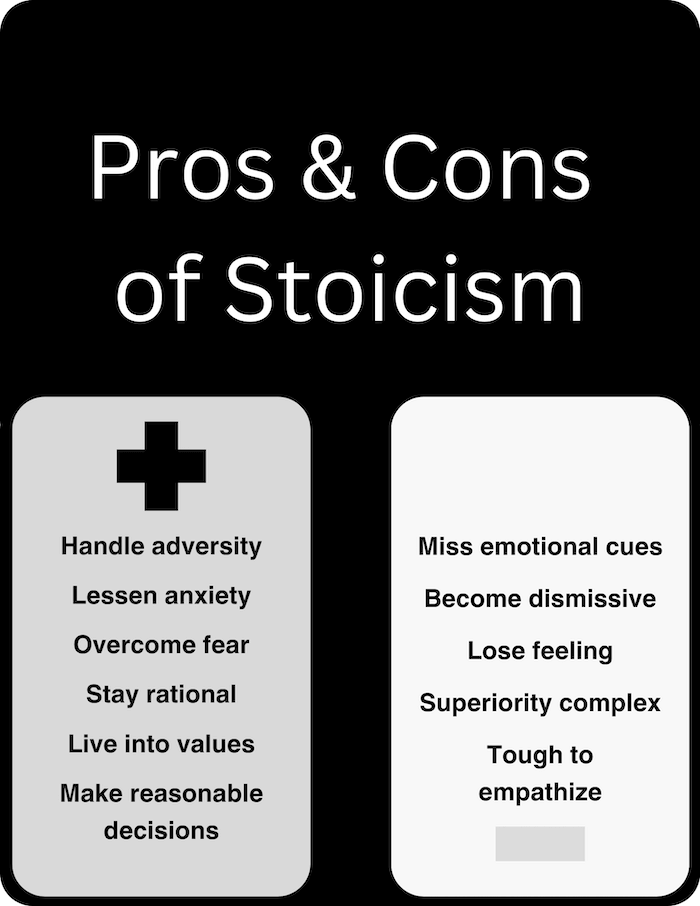
Pros and Cons List
Let’s take the stories above and make a quick, clear list of this, so you can easily apply it for yourself. Here are the pros and cons:
Disclaimer: these pros and cons come from personal experience. Any fault in applying the full Stoic philosophy correctly is my own.
Questions a Stoic Must Ask… Eventually
As my kids got into preschool and early grade school, I learned they were experiencing and displaying a whole slew of emotions that I had no idea how to handle. My wife was helping them emotionally, but I wasn’t. I certainly couldn’t help them talk through it, think through it, learn to manage it, because frankly, I hadn’t talked through, thought through, or learned to manage my own emotions.
This forced me to look even harder in the mirror. I had to decide, for the sake of my wife and my kids, for the sake of growing a healthy marriage and raising healthy kids, if I was going to learn how to handle my own emotions.
Was I going to acknowledge that I actually had emotions, more than one or two?
Was I going to delve into the real issues that were bothering me deep down?
Was I going to acknowledge and accept past hurts, as well as past accomplishments? So I could feel both the hurt and the joy in those experiences?
Was I going to face my childhood and the moments that shaped me the most? Good, bad, and ugly?
Was I going to acknowledge that I, too, had a heart and not just a head? That I was an emotional being as well as an intellectual being? I was not just the Tin Man, R2D2, or the Grinch?
Was I going to start working through this on my own, or with help, or both?
Was I going to shed Stoicism entirely or keep the good parts of it?
A More Nuanced View of Stoicism
Ultimately, I couldn’t just throw out Stoicism. It had served me so well through so many tough situations in life. And I knew there would certainly be more tough things to come.
But I also knew I had to face the hurt, scared, and displaced little boy who was hidden behind this tough exterior. I knew I had to shed this coat of armor because I had a chink in it, where my heart had been pierced.
I was wounded, and I couldn’t fight any more battles until I got healed up and healthy.
So, I started working through all the hurt, the pain, the moments of good, bad, and ugly. I admitted I had a heart and a head. I acknowledged that I had a lot more than one or two emotions and I started naming them.
I did this on my own, I did this with my wife, I did this with my children, and I did this with counseling.
For the deep, inner work: I went to counseling and received some tips. I wrote and journaled, more than usual. I used prompts to get clear on how I felt. I listened to emotional and mental health books. I also listened to podcasts on similar topics. I took a few solo trips, some close to home, one across the ocean to Ireland.
Basically, I went hard in the paint to learn what emotions were, how to acknowledge them, and how to manage them. And I did the solo trips because I needed full separation and space to get clear on who I was, where I was doing well, where I was falling short, and who I needed to become. (See the One Page Life Plan review I wrote for an in-depth look at those self-improvement goals.)
While I know I’ve made a ton of progress from where I was 5 years ago, and leaps and bounds in the last 2 years, I know there is still so much further to go.
Next Steps
I’ll be continuing to work on this more balanced view of Stoicism, growing into an emotionally healthy man, husband, and father.
I hope you’ll be doing the same.
If you need any help along the way, please reach out on social. And this resource may help you out as well.
Processing…
Success! You're on the list.
Whoops! There was an error and we couldn't process your subscription. Please reload the page and try again.
As a dad of four kids, I’m qualified to write this one. Although let me be clear, I am not qualified to give birth or deliver a child.
I’m simply telling you from a husband’s perspective, with input from my wife, as to what the emotional rollercoaster of pregnancy looks like for the two of you.
Here’s how the rollercoaster of pregnancy looks 80% of the time:
Let’s begin with a couple disclaimers, just so you know you’re in good hands:
First, we’re not having a full birds and bees discussion here. This isn’t 7th grade health class, and I’m not drawing diagrams on the board for you all to figure this out!
Second, I’m not so naive to say all pregnancies start the same, especially with medical advances like IVF, IUI, ICSI, etc. There are many alternative ways of getting pregnant that don’t involve the traditional method.
Third, I’m also not so naive to say all pregnancies begin on an emotional high. If you got pregnant the traditional way, but the sex wasn’t consensual for any reason whatsoever, I’m so sorry for you. That’s an incredibly difficult thing to live through, and I encourage you to seek professional help to work through all the emotions of that experience and now being pregnant.
Last thing, I’m well aware that not all pregnancies make it to a full-term, healthy birth. My wife and I have had 2 miscarriages, my parents had 2 miscarriages, many of our friends have had miscarriages, and I can only imagine how heartbreaking it would be to carry well into the 20 or 30 week ranges and deliver stillborn or so early that the baby couldn’t make it. A dear friend runs a podcast for women who have had miscarriages and if you need some love from other mothers, check it out. It’s called Yet We Thrive.
Now, for those of you who had the traditional conception experience, with a person you loved, here’s the deal:
Getting pregnant was probably an exciting adventure! Perhaps you were trying hard, practicing daily to get pregnant. Maybe you weren’t trying at all. Maybe it was a total surprise!
But for a night, or for a few days, love was in the air, and you were eager to do some math with that person. 1+1 became 3, or 4, or more.
Stage 2: Excitement (or Dread) After the Test
The challenge in Stage 1 is that you often don’t know whether you were effective or not. Sure you had sex, you had fun, you enjoyed intimacy with your partner, but did the sperm successfully make the journey? Was the egg receptive? Did anything magical happen?
You usually don’t know for a few weeks, and during that time, you’re living in a big question mark.
Some tell tale signs, before getting a positive pregnancy test are:
Sudden food aversions
Feeling of gaining weight, without reasons for it
Sensitivity to smells
Feeling sick, without having the flu
Husbands, if you can positively identify these by listening to your wife, you might want to buy her a test.
Usually, the pregnancy test is a reliable indicator of whether you’re pregnant or not. But you’ll eventually want to go to the doctor to confirm and get on a prenatal plan of care.
As for the emotional rollercoaster at this stage of pregnancy, for many couples, it is a huge wave of all the emotions!
If it’s your first, you may be high-fiving and hugging and crying tears of joy. It may be one of the most exciting days your lives. Or, some guys, you may be peeing down your leg, scared to death at how you’re now going to be a dad and have to provide, while the lady is elated and beaming. (This is the guy’s first time peeing down his leg. Ladies, your time will come later.)
If it’s your second or third, you may have felt totally ready for this and excited to start another round. Or, you may be wearing a face of shock and fear, like what just happened?! How are we going to manage another one?! Discovering you’re about to have a 2nd or 3rd child can often lead to the most mixed emotions, depending on how close the siblings are, how financially ready you are, how well the first one went or didn’t, and how many kids you were expecting to have in total.
If it’s beyond your third, you may just be laughing and shaking your head with your spouse at each positive pregnancy test. By this point, you feel like old hats at this. You might consider yourself on the Honor Roll or Dean’s List considering how many tests you’ve passed at this point.
Regardless of the response, or the number of children this is, you usually hit a point of excitement! For my wife and I, on number four, we walked around in a daze of disbelief for a few days, then hit a stage of excitement. Whether you’re excited the day of the positive test or a few days later, you and your partner know that a new life is already forming inside.
Stage 3: The First Trimester Morning Sickness
I’m amazed at what women go through in the first trimester. Women are built extra tough! I’ve told my wife many times that if I was pregnant, I’d be on bed rest from the first week to the day of delivery. Thank God I can’t get pregnant!
Men, your job is to be compassionate, helpful, and take care of as much as you can during this stage of the pregnancy. Your lady is going to feel depleted, zapped, exhausted.
Of course, it depends on each woman, because every pregnancy is different and every woman has different health experiences, but suffice it to say, I’ve never met a woman who said first trimester of pregnancy was easy.
I asked my wife, “How would you describe first trimester?”
She smiled and she said, “Oh, it’s great! Just really great. It feels like all your energy is sucked out of you. The nausea in the morning is intense, some days you throw up, then you feel queasy most of the day, every day. Then the nausea returns in the evening. You feel like you have the stomach flu for weeks.”
Wuff! You heard it straight from a woman who has lived through it multiple times.
Stage 4: The Second Trimester Superwoman
Men, you’ll know when you hit second trimester because the lady suddenly has energy again. And she has a lot of energy!
Often times, men, you’ll breathe a sigh of relief because now the woman can contribute again. In fact, she may be running circles around you. She hits an amazing new stride. She might wake up at 5am, make everyone breakfast, clean the house, get herself ready for work, work all day, run errands in the evening, and still have energy for anything else she decides to do at night.
What is Nesting?
This is also usually where nesting happens. What is nesting? It’s the time when the woman starts prepping for the baby. She sets up the baby registry, wants a hundred house projects done, preps the baby’s room, and buys everything she didn’t put on the registry.
You, sir, are about to be inundated with baby stuff. You had no clue a little 20-inch long, 7-lb human could need this much stuff!
I asked my wife, “How would you describe second trimester?”
“You usually get a second wind and feel a little more normal. You’re hungry a lot. The frustrating thing, for most women, is your clothes stop fitting. I gained 30 lbs in the first 20 weeks.”
She’s selling herself short on how much energy she usually had in second trimester. The main exception to this rule is if the woman has any pregnancy conditions, like gestational diabetes, preeclampsia, etc. That can really drag down her energy.
For most men and women though, second trimester is the sweet spot of pregnancy.
Stage 5: The Third Trimester Discomfort
Decide now that you’re going to step up your game as a husband and dad in third trimester. Run more errands, cover more kid activities, learn how to give good massages to your wife, and help out with more chores around the house.
Your wife will be in extreme discomfort, and you’re going to need to cover a lot of ground to help the family function at top-notch.
I asked my wife, “How would you describe third trimester?”
She said, “Don’t talk to me!”
No, that wasn’t her real answer, but that’s oftentimes how she feels. Let me go lay on my bed, wrapped around my pregnancy pillow, and not have any responsibilities.
What she actually said was, “Imagine having two cantaloupes strapped to your chest, one watermelon strapped on your belly, and that your legs, arms, hands, and feet have water injected into them. None of your clothes fit, you lose your breath quickly, and your brain feels foggy most of the time. That’s how third trimester feels.”
She’s in the home stretch, the final leg, the fourth quarter, the ninth inning, the third period, the 90th minute, depending on what sport you prefer.
Be kind, be helpful, and be present. When she’s finally ready for the baby to come out, she might be interested in sex again. But only for the purpose of getting the baby to come out! 😉
Stage 6: The Delivery Day Labor
Delivery day can be a whirlwind, a rush, and a borderline scare.
Or, it can be a low-key, semi-laid back, calm day.
A lot of this depends on how soon you get to the hospital, how great your doctors are, how many health issues your wife has, and how healthy the pregnancy has been up to this point.
My wife scared me with a couple of ours because we arrived at the hospital so late in the game that we basically had the baby within an hour or two of checking in.
But with our most recent one, she was laboring more slowly, we lived further away so we had to plan ahead a bit, and we were there for a whole twelve hours before the little guy made his arrival.
Epidurals can change the entire birthing experience too. (These are intense pain meds injected into the back of your wife.)
C-sections (Cesarean births) can also present an entirely different birthing experience. I was born as a C-section birth, but I can’t speak to it because my wife has never had one. It is more surgical, with cuts to the abdomen to bring baby out via the abdomen, instead of vaginally. I also know the woman’s recovery can be tougher and longer because her abs were just cut in half. Ouch! Either way, ouch!
Regardless of how it all goes down, your job as a dad is simply to cheer your wife on in the way she needs it, rub her back, shoulders, or feet if she needs it, and basically let the doctors do their thing.
Stage 7: Baby Arrives!
You’ll be absolutely amazed when you see your little one arrive!
You might be grinning from ear to ear. You might be laughing with joy. You might even be so overcome with emotions that you just cry.
I’ve done all of those.
Generally, a healthy birth is met with joy and excitement and feelings of pride.
If you do good as a supportive spouse, the docs and your wife will let you hold your little son or daughter after mom gets her fill. And man, what a feeling!
Soak it up, enjoy it! Hold that baby close and kiss him or her. Tell your wife how awesome she is!
Then, enjoy the hospitality of the hospital.
You might get a halfway decent meal. You might sleep a couple hours on a rock-hard cot. Then, if mama and baby are healthy after 24-ish hours, you’ll get to leave. Drive safe and slowly on the way home, for mama’s sake and for baby’s.
Stage 8: The First Couple Months
I hope you get some time off after the baby arrives because you’re going to need it. Mama needs it for obvious reasons, like just pushing a 7-pound human out of a small orifice. She’ll need at least six weeks of recovery. (Make a mental note.)
But you’ll need some rest too because this baby is going to put you through some sleepless nights. The good ones wake up every 1.5 to 2 hours to feed. The struggling or challenging ones will wake up even more often crying, fussing, and in a generally disgruntled mood.
Hopefully, you get a good and content one. If not, just remember there’s probably something your baby needs but isn’t getting. Or, there’s something they’re struggling with, like digestion. This can be helped with a few tweaks to momma’s diet, a little gas medicine (like mylicon), or some post-natal checkups with Doc.
Remember, the baby doesn’t just have it out for you every time they cry. Don’t take it personally. They’re just trying to adjust to life outside the womb.
Your baby’s job is three-fold in the first few months: eat, sleep, and poop.
Your job in the first few months is to buy diapers, change diapers, and get your breast-feeding momma constant refills of water. You also get to nap with baby, if you take naps.
If all this happens, and you’ve kept your sanity, then consider it all a success!
Congratulations! Now, keep them alive, teach them what you know, and learn a couple good dad jokes. You have at least 18 years to impart your wisdom, but only about 12 where they’ll actually listen to you.
You got this, dad!
A Gift for the New Dad
I wrote this book for dads (like you). It’s becoming a favorite back-of-the-toilet decoration for dads across the country. Just check out the reviews on Amazon!
(This post is dedicated to my buddy Chad Aleo, over at High Ticket Sales Advice. His first baby is on the way and he asked for me to share some dad wisdom with him during his wife’s pregnancy.)
The song Fast Car came on the radio, and I thought, “Man, this sounds familiar.”
It was like I already knew the lyrics, intrinsically, but the voice seemed so different than how I remembered it.
I sang along to the parts I knew, told my wife I needed to look it up when I got home, and sure enough, I was onto something. In this brief article, I’ll breakdown where the song came from, what it means, why it’s significant, and what we can learn from it.
The original Fast Car song was written and performed by Tracy Chapman.
It was released in 1988 as part of her debut album.
Tracy, a black woman, grew up in Cleveland, Ohio, an industrial city with a mostly blue collar background.
In an interview with the BBC, she said she saw the song as a way to express the stories of the people she saw and knew growing up, who were struggling, working hard, hoping things would get better.
Now, in 2023, Luke Combs, the famous country star, is performing the song and it has become a hit on the Billboard Charts for multiple weeks. He’s said that he’s been performing the song at live shows for over 6 years now and crowds across the country relate to it. Here’s why everyone can relate…
The Meaning of Fast Car
Fast Car is about a young couple, trying to escape their current reality and create a new life together. But they encounter the same challenges of their past and struggle to find a path forward.
Of course, you can read multiple people’s interpretations of the song on Reddit, music forums, and other places on the internet.
At it’s core, the song Fast Car covers themes of:
Poverty
Alcoholism
Generational cycles
Running away from the past
Heartbreak
The power of hope
The American Dream
Young love vs. old love
The bliss of new couples
The consequences of bad choices
The first couple themes mentioned seem obvious to most listeners. The lady in the song grew up with an alcoholic dad, had to take care of him using her own meager paycheck from working at a convenience store, and now decides it’s time for her to go live her own life.
So many people can relate to this, right? Living in poverty, with an alcoholic parent, and feeling like they have to raise their own parents.
But many of the interpretations I’ve read overlook the power of hope. And what about the bliss of new couples?
“Your arm felt nice wrapped around my shoulder.”
She had a feeling that she belonged and she could be someone. She had hope for a new life, a place where she was valued and loved and cared for, instead of having to be her dad’s caretaker.
That’s what young love feels like.
The couple is ready to run away from their past, to move to a big, new city, create a better life for themselves, and they have dreams and plans of both working in meaningful jobs. They’ll get promoted and move to the suburbs.
This is the dream of so many people, the American Dream, if you will.
So she gets her job and pays all their bills, but he never gets a job, never does his part. He becomes the deadbeat dad to their own kids, becomes the alcoholic himself. The generational cycle continues.
And it makes you want to cry, right?
All these hopes and dreams just going down the drain.
The heartbreak, the turmoil, the 2am fights when he comes home drunk from the bar, and the kids are woken up to their parents fighting.
As you see the story develop and you feel the situation escalate, you want the young man to grow up. You want him to figure out his own life and quit being a deadbeat dad. You want him to leave the bars and step into his role as a husband and dad.
But you know it won’t work out.
It won’t work out unless something drastic changes. Unless the woman puts her foot down and tells him he has to leave.
So she does.
She shows old love.
The old love, the mature love, the love that says, “I love you too much to let you keep destroying yourself. I love you too much to let you waste away. I won’t let this generational cycle happen to us too. I won’t let you destroy me and the kids, like my dad almost destroyed me. I won’t let it happen.”
So the song ends, “You got a fast car. Is it fast enough so you can fly away? You still gotta make a decision. Leave tonight, or live and die this way.”
Will the wife force the husband to leave?
Or will she have to take the kids and leave?
And what happens next?
Will he live in self-pity and become another lonely alcoholic? Or will she stay and die on the inside watching him destroy himself and give up on all her own hopes and dreams? Will resentment and bitterness win?
Or will the cycle be broken?
We’re left with a giant question mark. And it’s the most beautiful ending.
What Can We Learn From The Song
That, in my mind, is why Fast Car is such a hit. The beauty is that it ends in the open question: What’s going to happen next?
Are you going leave tonight, or live and die this way?
Every single day, couples live through this experience. Maybe it’s not alcoholism, maybe it’s a drug or porn addiction instead? Maybe it’s not poverty they’re leaving, maybe it’s leaving the overbearing and controlling rich parents who are funding everything and now they’ll have to risk it and make it on their own? Maybe it’s not going to live in the city, but it’s escaping the city to go live in the country?
But the couple has a dream. Then the young couple faces real life, tough situations, setbacks and challenges, some self-induced and some external hardships. And you come to a point of decision.
Are you going leave tonight, or live and die this way?
My wife and I lived through this point of decision a few times. Man, is it painful!
But every time, we’ve refused this dichotomy. There’s no car fast enough to fly away. Running from our problems will never result in the life we want. On the other hand, neither of us are going to accept living and dying in misery.
So we’ve consistently chosen the third option.
To suck it up, work on ourselves, each get better, and break the generational cycles.
And that third option, my friends, is a beautiful way.
Are you going leave tonight, or live and die this way?
Or, will you live into the third option?
PS: I’ve made a resource to help people who are trying to live into the third option. There’s no obligation to take it, but if you want it, here it is and I know it’s helped a lot of people, including myself.
Processing…
Success! You're on the list.
Whoops! There was an error and we couldn't process your subscription. Please reload the page and try again.
Today was Sunday. I didn’t go to church. Even though I’m a Christian, who has attended Bible College and seminary, actively following Jesus, and living in the U.S., I didn’t go. Why is that?
Practically speaking, my son had a hockey tournament. But even so, I’m probably not going.
The reasons are many. The reasons are deep. Usually, that answer is enough for people who ask me.
But others are actually asking for more of an answer. They genuinely want to know: what is the main problem in Christianity? What’s wrong?
Why would a guy like you, who takes your faith so seriously, quit going to church? And not just for a couple weeks, or even a couple months, but a couple years? Four or five years out of church? Why?
Well, my friend, buckle up and let’s go on a journey. This isn’t going to be all about airing out my dirty laundry or others’ dirty laundry. This will include personal experience, but it will also include deeper observations about the state of the church in America, the institutions and social structures, and the underlying trends and currents I’m seeing.
Let’s start with some basic trends, aka observations in the news. The first problem with Christianity may not be unique to the church, but it’s one that Christians must learn to adapt to if they plan to have any positive impact in culture:
Most people have shorter attention spans, so sitting through a 45-60 minute “sermon” or “lecture” isn’t appealing. Source: Ranieri and Co
Denominations across the board are experiencing declining numbers. Source: Christianity Today
Big denominations have had lawsuits and scandals amongst their highest ranks, most recently the Southern Baptist Convention’s sexual abuse scandal. Source: The Guardian
Political bigotry and nationalism have hit new levels in churches. Source: The Atlantic
Pastors are not seen as trustworthy, and people (including myself) are becoming more skeptical of their motivations and character. Source: Barna Group
On bullet point one, I can sit and focus for incredibly long periods of time actually, so I don’t struggle with that. What I struggle with is a trend toward fluffy sermons, unprepared sermons, and/or lifeless sermons. I want to know the pastor prepared, that he or she means it, that they live it with conviction.
On two, I struggle with pretty much every denomination, even the “non-denominational.” Too much human interference and red tape, or simply irrelevant.
On three, it’s atrocious. Gross and unacceptable.
On four, the same.
On five, yeah, I’m in the skeptical 24%+. Given the scandals of Hillsong, Ravi Zacharias, Bob Coy, and so many others, I’m not defaulting to trust when I meet a pastor.
Now, I have a couple friends who are pastors (or former pastors) and they’re great. But anytime I meet a new one or hear about a new one, I’m guarded.
What Happened to Me
I promised I wouldn’t make this all about airing my dirty laundry. I’m simply trying to answer the question of what’s the main problem in Christianity and why I don’t go to church, in more depth.
Here’s what has happened to me personally, in a nutshell (you’re welcome to stop reading anytime if you don’t want to hear it):
My parents were lied to by a pastor when I was a kid.
My sweet ol’ grandmother, who had a true giver’s heart, was taken advantage of by TV preachers doing the prosperity gospel tricks of the 1990s.
When I went to Bible college in 2006-2008, I started reading “emergent” and “unorthodox” books. Due to my wide reading and desire to study broadly, the leadership refused to put me on staff and warned people to be careful in their conversations with me. I felt like I got excommunicated. Not burned at the stake, but definitely banished like a leper outside the camp.
After I licked my wounds and recovered from that experience, my wife and I attended a wonderful church in Portland, Oregon for a year. Then, upon moving back to the midwest, we really struggled to find any place that was open-minded enough to settle into. Met some great Christians, some not so great ones, but it felt like we were just going through the motions.
Eventually, a few years later, our family found a church in Ohio that we liked. We got plugged in. They needed volunteers. We volunteered for pretty much everything. Then, I burnt myself out on doing too much. Then, a couple controversies came up that made us cringe at what leadership was allowing. Then, something happened to my wife…
What Happened to My Wife & Other Women
I’m astounded that my wife will step foot in a church. She was harmed, threatened, mistreated, and abused “in Jesus’ name,” as a child and as an adult.
While I don’t want to tell her entire story in this article because it’s not my place and parts of it are already in a book, suffice it to say, it hasn’t been pretty. As a kid, she was raised in multiple unhealthy churches, along with an unhealthy family, and all kinds of unacceptable behavior in both.
As an adult, she had to step down from a leadership position because people in church were uncomfortable with how strong of a presence she was, how pretty she was, and how she lived and spoke with conviction when she was allowed to share in groups.
After she wrote her book, many other women began to confide in her that they experienced similar things. Again, not my place to share their stories, but I can say this in full truth and sincerity:
So many women have been abused in the church. Sexually abused, verbally abused, emotionally and mentally abused. Told they’re too much. Told they’re not allowed to lead or speak. This should not be so.
I won’t stand for it when I see it happening in a church, or even in the workplace. Women should be treated as the crown of creation that they are.
What We All Crave vs. The Current “Christian” Groups
I firmly believe every human, extrovert or introvert, craves connection. Even an extreme introvert like myself craves connection. I don’t want it with thousands of people and loud crowds. I want it with a few close friends, mentors, and mentees.
Deep relationships, a supportive & diverse community, and intimacy with my spouse. That’s what I want, and I’d venture to say that’s what you want.
Over the years, my wife and I have encountered many different walks of life in our friendships and relationships. Here are the patterns we’ve found: the “Christian” group has tended to be full of cliques, backbiting, hypocrisy, and pettiness. Not always, just often enough to be a trend. But…
The practicing pagans, the non-religious (aka the Nones), the agnostics, the Jewish, Muslim, and Buddhists have been the folks we’ve connected with on a deep and meaningful level. We have more authentic relationships, more honest conversations, and frankly, more fun. We smile more. We laugh more. We just enjoy these folks more.
So, I call these folks my friends. That’s my “church.” A community of misfits. A group of folks who know how to be real with each other, who don’t always agree, but always love to help each other out. I spend time with them on weekdays, in the evenings, on random Saturdays. When I read 1 Corinthians or Ephesians, this sounds a lot more like the type of group Paul was encouraging.
It wasn’t “Christian” groups that had polished Sunday services, with a mini-concert, perfectly timed transitions, shallow prayers, and self-help sermons with powerpoints.
Paul’s churches didn’t have coffee lines, their own radio stations, Christian hoodies and trinkets for sale, pastors wearing $10,000 watches, $500 boots, and designer shirts or suits posing on magazine covers.
Church was supposed to be a house of prayer and meeting people’s needs, not a house of merchandise. Jesus said something like that, right? When he flipped the tables?
When Jesus hung out with his disciples, it was a group of ragamuffins, searching and trying to find God, trying to live into honesty, integrity, love, joy, peace, and all the rest of it. Failing at times, but failing forward and getting up, not backward.
When Paul wrote his letters to the various churches, some were Jewish, some were Christian, some were pagan, some were seekers.
Misfits, on the fringes, but genuinely trying to seek and find God.
A Call for Reform
That, my friends, is why I’m seeking reform. I don’t know if I’ll post my own version of the 95 theses, like Martin Luther, anytime soon. But I’m not going to church, not in a modern, evangelical, American church.
I’ll try something distinctly different.
Perhaps older, more community-driven, less facade.
Maybe a new thing, a fresh thing, deeper and raw, a space that welcomes all.
That’s my type of church.
If you enjoyed this post, you might enjoy one of my books. (Just click the image below)
I used to have a rigid routine of reviewing my One Page Life Plan each quarter. The past couple years, it’s been more of an organic happening. I feel a shift in my bones, I listen to it, and I take a couple hours on a weekend to sit with it.
Anyone who knows me well knows that I am a goal-oriented person. As some wise ones have quipped in the past,
“If you aim at nothing, you’ll probably hit it.”
Anonymous
Well, I’m in the opposite boat. I’m certainly aiming at something. The target is, “Well done, good and faithful servant.”
The way I get there is by following my One Page Life Plan and setting yearly goals. I’ve been doing this for almost 10 years. And I set them in accordance with the wheel of life.
In this post, I want to break down the season of Summer 2022, on my way toward that target:
Family Goal 1: Improve our marriage in consistent, tangible, meaningful ways
Family Goal 2: 1 date per month with each kid, meaning each kid gets 1 per quarter
On the first family goal, my wife and I have had our best year of marriage, for sure. I’ll spare you all the juicy details (maybe share another time), but last year was rough for us. Last summer, we came very close to separating. But I worked on myself in counseling and she kept working on herself in counseling, and we had some very candid conversations to sort through past junk.
This year, our marriage is much better.
Still areas for improvement? Yes.
Still need to continue working on ourselves individually? Yes.
But she would say and I would say, we’re in a much healthier place. Some of this has come through date nights and more intentional time together. But a lot of it has just been better communication: telling each other how we’re feeling, showing each other compassion, and picking up the slack when the other is struggling. Seeing and listening. Really seeing. Really listening.
For the second family goal, I’m right on pace. Each kid has had 2 dates with me so far and the 1-1 time is huge. They really look forward to it, and if you’re a parent, this is a great practice to start.
Author Goals
Author Goal 1: Sell and market my existing books better
Author Goal 2: Revise and re-release an old book with a new spin
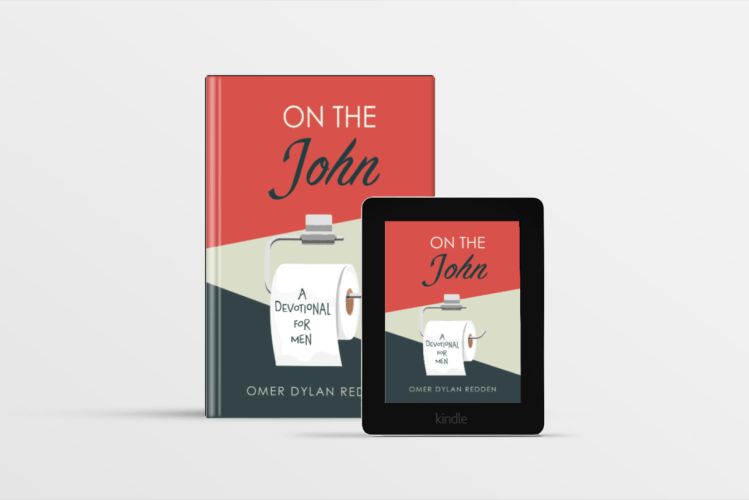
The first author goal is going well. I’ve run a couple giveaways, I’ve run Amazon ads, and I was able to have my highest sales month, outside of a launch, with 300+ books sold. My book, On the John: A Devotional for Men, has been selling very consistently all year long.
My re-release is in the making.
Health Goals
Health Goal: workout 3x per week to look chiseled and fit at 35-36
I don’t know if I’ve say I’m chiseled, but you can see my abs at 35. And I am working out 3x per week. Stretching more than lifting.
Travel Goals
Travel Goal: Go to 12 places I’ve never been
I’m just a smidge behind pace on this goal. Gas and flight prices have put a bit of a damper on my original plans. So instead of going long distances to far away lands, I’ve found myself going to more nearby places that I haven’t been to.
Regardless, it’s always fun to get out and get away.
Finance Goals
Finance Goal: Invest set amount per month with 33% return
Finance Goal: Follow budget within 10% and give more consistently
Finance Goal: Max the match on 401K
I’ve been investing very heavily, but in a different direction than I normally would. I would say we’ve been spending over budget because of all the travel we did for baseball this summer and because of Hannah’s Mrs. Wyoming and Mrs. America competition. But I’m happy to be over budget on those things. On pace to max the match.
Spiritual Growth Goals
Spiritual Growth Goal: Write 12 blog series and plan Bible reading
Man, it’s tough to write this one out. I have fallen off my Bible reading plan. I’ve been reading, but it’s been sporadic. And for blog series, I think I’ve completed 4 on the year, when I should be at 7.
Perhaps, I shouldn’t have measured the goal in this way. Because what’s happened is I feel closer to God than I have in awhile. I’ve prayed more, I’ve read more, I’ve been more open to the still small voice.
But if I want to hit the goal as I wrote it out originally, this is the one goal that I really need to improve on so I can finish strong on the back half of the year.
Theme of the Year
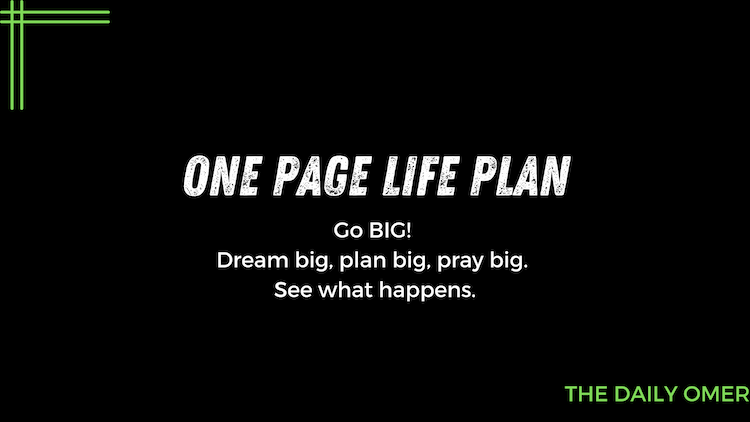
Theme: Go BIG! Dream big, plan big, pray big. See what happens.
This has been green all year long. I’m really excited about what I’m working on, where things are heading, and what’s coming.
Merriam-Webster defines “imprecate” in this way: to invoke evil upon; to curse.
Other synonyms might be:
Ban
Afflict
Maledict
Anathematize
Vigorous denunciation
I love words, but those sound pretty rough, right? Who would ever wish those things upon someone?
I can almost hear the spelling be judges now…you’ve spelled it, you’ve defined it, now could you use it in a sentence please?
Sure! Let me give you a quick example of how you could use imprecatory in a sentence and where it would make sense:
If you’re a parent and someone purposefully harmed your kid, would that get you fired up?
What if that person sexually abused your kid, would that get you fired up?
What if that person was someone in your own family, or someone that you had trusted, would that get you fired up?
It would get me fired up.
I would, for sure, pray imprecatory Psalms on that person!
So there’s a definition and example of where an imprecation would be feasible.
If you’re calling upon a power (or God) to send injury to another, it better be for a darn good reason.
What are the imprecatory Psalms?
The Psalms have a few different flavors, and they can be divided in a myriad of categories, depending upon who you ask. I’ll divide them up in this way:
Imprecatory Psalms
Celebration / Praise Psalms
Lament Psalms
Wisdom Psalms
Remembrance / History Psalms
The imprecatory Psalms are actually quite abundant. All of these Psalms include prayers against an enemy, and the lines in them aren’t exactly the type of things we’d expect a “saint” to say:
Psalm 7, 35, 55, 58, 59, 69, 79, 109, 137, 139
Now, you have some Old Testament proof that imprecatory Psalms are ok to pray. But I can already hear the dissenters, “But that was the Old Testament, and in the New Testament, Jesus tells us to love our enemies and pray for those who spitefully use us.”
And here’s my reply:
Yes, Jesus did say that. But Jesus also called the Pharisees to the carpet in Matthew 23. That whole chapter sounds like imprecations to me: “Woe to you, scribes, Pharisees, hypocrites!”
And Jesus also flipped over the tables (and made a whip to drive out people and animals) in the temple courts, because they had made it a den of thieves instead of a house of prayer.
And Peter and Paul invoked some curses upon folks in the book of Acts. And Paul invoked some curses in Galatians and 2 Timothy.
For many centuries, the test of doctrine has been:
Was it taught or demonstrated by Jesus?
Did the apostles do it in Acts?
And is there teaching or examples of it in the epistles / letters?
If the answer is “yes” to all three, then it’s good to be accepted. It sure looks like imprecations upon the enemy are still acceptable.
Now, should we work to forgive the transgressor? Absolutely. But forgiving is not the same as reconciliation. Forgiveness doesn’t mean we accept what they did as right. It doesn’t mean we have to have a good relationship with the person. As Mike Foster has said:
“Sometimes continuing the relationship is both impossible and inadvisable.”
Mike Foster
Now that you know what the imprecatory Psalms are, where you can find them and other imprecations in the Old and New Testament, it’s now time to answer the question:
Can I pray imprecatory Psalms? Should I pray imprecatory Psalms?
I think you know where I’m going with this. It’s true: people offend us, annoy us, or harm us, and we get upset. Rightfully so. That’s our sense of justice kicking in. If you weren’t getting fired up at the example I shared in the first section of this post, then I’d check your pulse.
But we also know our own limitations, and we know we shouldn’t take revenge, so we have to ask for help from above. Perhaps God will see fit to handle that person for us.
There is nothing wrong with praying imprecatory Psalms. We can be honest with God in our hurt, our pain, our grief. He’s big enough; He can handle it.
In fact, we should be honest with God in our hurt, pain, and grief. If we can’t be honest in our private prayers to God, who can we be honest with?
So yes, you can pray imprecatory Psalms. Yes, you should pray imprecatory Psalms. If David, Jesus, Peter, and Paul did it, you can do it too.
Just be careful you don’t do something to be on the receiving end of someone else’s!
If you have experience praying the imprecatory Psalms, let me know in the comments.













 Omer Redden