Part of me loves Stoicism. Part of me hates Stoicism.
In this post, I’ll share my love / hate relationship with Stoicism and how it can both help and hurt you as a young man transitioning through different phases of life.
Let’s explore the pros and cons of Stoicism:
- Stoicism as an Asset, aka The Good Parts
- Stoicism as a Liability, aka The Bad Parts
- Pros and Cons List
- Questions a Stoic Must Ask… Eventually
- A More Nuanced View of Stoicism
Stoicism as an Asset, aka The Good Parts
When life is flying at you like a 100-mph fastball, ready to hit you square in the ribs, you need something that helps you get out of the way.
Or, if you can’t get out of the way, at least you know you’re going to take the pitch hard on the ribs, you’ll be bruised for weeks, but you’ll barely grimace as you jog to first base and give a hard-line stare back at the pitcher.
You need David Goggin’s mentality that “you can’t hurt me.” The Marcus Aurelius quotes. The RedFrost Motivation on YouTube.
The trivial things of life won’t affect me.
Respond, don’t react.
I won’t be worried, anxious, scared at whatever comes my way. I’ll handle conflict and obstacles with an even-keel demeanor. Challenges will roll off my back like water off a duck’s back.
I love it!
I lived into that mentality during my teenage years and early adult years.
It helped me get through a number of tough transitions, tough situations, and tough relationships. (More on those another time.)
Stoicism allowed me to get married at 22 to a 19 year old, both of us being jobless for our first two months of marriage, dealing with a miscarriage, moving across the country, handling life with 3 kids under 4 years old, a failed foster parenting attempt, and living below poverty line for a handful of years.
Stoicism helped me muscle through 4 years of doing jobs I hated just to put food on the table and try to improve our lot in life.
As I got older though, maybe around 30, I started to realize that some of the Stoic philosophy wasn’t serving me.
It was great in theory and it had helped me through a lot, but it was starting to cause trouble in practice. In fact, Stoicism was transitioning into more of a liability than an asset.
Here’s what I mean by that:
Stoicism as a Liability, aka The Bad Parts
In real life, my wife was trying to navigate healing from trauma and abuse of various forms. She was trying to figure out how to draw the right boundaries with a toxic family. She was trying to get herself healthy and raise healthy kids – physically, emotionally, mentally, and spiritually.
She wanted a man who could feel, who could empathize, who could show that he actually cared about what she was experiencing. I had suppressed my own feelings for so long, I could hardly feel anything myself, let alone feel for someone else.
My wife might ask how I feel about something and I’d just shrug or dismiss the question.
“Omer, there’s more than a ‘meh’ dismissive feeling about everything in life. You need to learn how to feel.”
Hannah Redden
Honestly, I needed one of those emotion charts they use for kids in counseling, where you point to the emotion you’re feeling based on the face the little icon is making. There are 30 options to choose from.
I actually remember referencing it a few times in discussions. “Well, I guess a little of this (frustration), with this (sadness), with a tinge of this (anger).”
We even had a joke amongst my work colleagues that I only had two emotions: bad and even. They made a shirt for me that had the straight-faced, expressionless emoji. That was me, to a tee / T. No pun intended, but definitely appreciated.
So, my wife wanted someone who could feel, empathize, and care. I couldn’t do any of it.
Pros and Cons List
Let’s take the stories above and make a quick, clear list of this, so you can easily apply it for yourself. Here are the pros and cons:
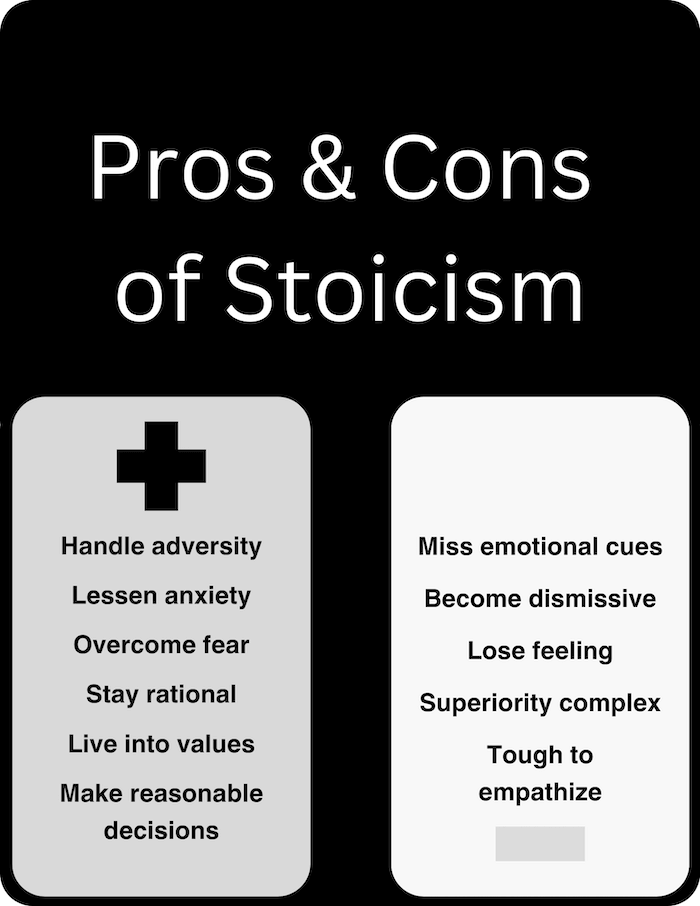
Disclaimer: these pros and cons come from personal experience. Any fault in applying the full Stoic philosophy correctly is my own.
Questions a Stoic Must Ask… Eventually
As my kids got into preschool and early grade school, I learned they were experiencing and displaying a whole slew of emotions that I had no idea how to handle. My wife was helping them emotionally, but I wasn’t. I certainly couldn’t help them talk through it, think through it, learn to manage it, because frankly, I hadn’t talked through, thought through, or learned to manage my own emotions.
This forced me to look even harder in the mirror. I had to decide, for the sake of my wife and my kids, for the sake of growing a healthy marriage and raising healthy kids, if I was going to learn how to handle my own emotions.
Was I going to acknowledge that I actually had emotions, more than one or two?
Was I going to delve into the real issues that were bothering me deep down?
Was I going to acknowledge and accept past hurts, as well as past accomplishments? So I could feel both the hurt and the joy in those experiences?
Was I going to face my childhood and the moments that shaped me the most? Good, bad, and ugly?
Was I going to acknowledge that I, too, had a heart and not just a head? That I was an emotional being as well as an intellectual being? I was not just the Tin Man, R2D2, or the Grinch?
Was I going to start working through this on my own, or with help, or both?
Was I going to shed Stoicism entirely or keep the good parts of it?
A More Nuanced View of Stoicism
Ultimately, I couldn’t just throw out Stoicism. It had served me so well through so many tough situations in life. And I knew there would certainly be more tough things to come.
But I also knew I had to face the hurt, scared, and displaced little boy who was hidden behind this tough exterior. I knew I had to shed this coat of armor because I had a chink in it, where my heart had been pierced.
I was wounded, and I couldn’t fight any more battles until I got healed up and healthy.
So, I started working through all the hurt, the pain, the moments of good, bad, and ugly. I admitted I had a heart and a head. I acknowledged that I had a lot more than one or two emotions and I started naming them.
I did this on my own, I did this with my wife, I did this with my children, and I did this with counseling.
For the deep, inner work: I went to counseling and received some tips. I wrote and journaled, more than usual. I used prompts to get clear on how I felt. I listened to emotional and mental health books. I also listened to podcasts on similar topics. I took a few solo trips, some close to home, one across the ocean to Ireland.
Basically, I went hard in the paint to learn what emotions were, how to acknowledge them, and how to manage them. And I did the solo trips because I needed full separation and space to get clear on who I was, where I was doing well, where I was falling short, and who I needed to become. (See the One Page Life Plan review I wrote for an in-depth look at those self-improvement goals.)
While I know I’ve made a ton of progress from where I was 5 years ago, and leaps and bounds in the last 2 years, I know there is still so much further to go.
Next Steps
I’ll be continuing to work on this more balanced view of Stoicism, growing into an emotionally healthy man, husband, and father.
I hope you’ll be doing the same.
If you need any help along the way, please reach out on social. And this resource may help you out as well.




 Omer Redden